CSP private offer vs Resale Enabled Offer
Two models, one goal: selling through channel partners on Microsoft Marketplace. They work very differently — and mixing them up creates real problems for ISVs and partners alike.
The key difference in one sentence: A CSP private offer gives a margin to a CSP partner who then bills the customer themselves outside Marketplace. A resale enabled offer (REO) authorizes a partner to transact on Marketplace on the ISV's behalf, with Microsoft collecting from the customer.
🟣 Model 1 — CSP private offer
The ISV creates a time-bound margin (discount off list price) for a specific CSP partner in Partner Center. The CSP buys at that wholesale price and is fully responsible for pricing, billing, and the customer relationship. Microsoft never interacts with the end customer on this transaction.
Transaction flow
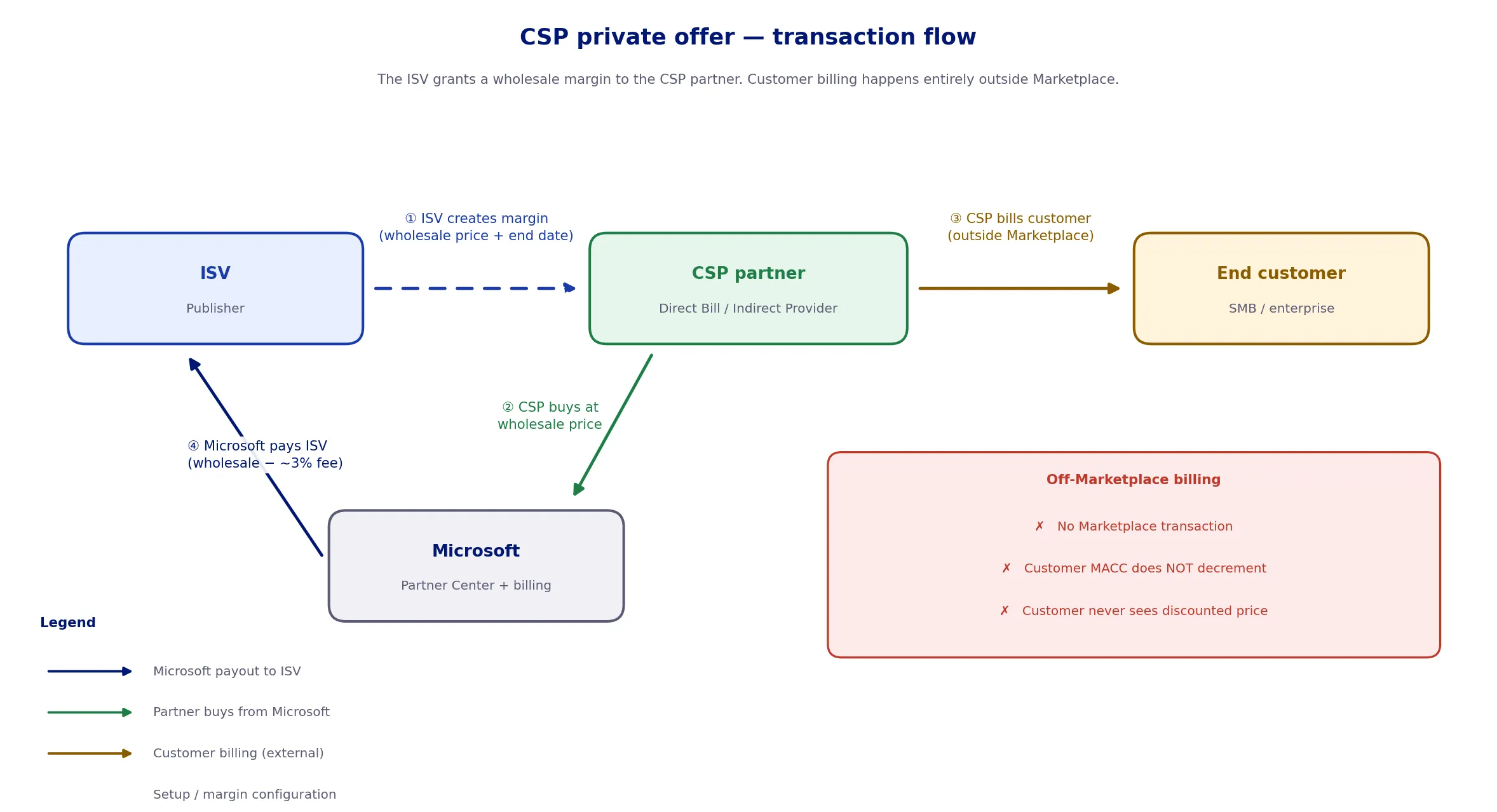
The customer billing happens entirely outside Marketplace. The customer never sees the discounted price and the purchase does not decrement their MACC.
Key facts
Dimension | Detail |
|---|---|
Who creates the offer | ISV in Partner Center — one margin per CSP partner |
Who sets customer price | CSP partner — full control, managed externally |
Marketplace transaction | No — customer billing happens outside Marketplace |
MACC eligible | No — does not decrement customer MACC |
ISV gets paid by | Microsoft (at wholesale price, less ~3% fee) |
Customer accepts offer | No — no acceptance step, CSP manages everything |
Margin locked once sent | Yes — ISV cannot change before end date |
🟣 Model 2 — Resale enabled offer (REO)
The ISV authorizes a channel partner once in Partner Center. After that, the partner independently creates and manages private offers for customers — no ISV involvement per deal. The customer transacts directly through Marketplace (Azure portal), Microsoft collects payment, and pays the resale partner. The partner then pays the ISV externally per their own agreement.
Transaction flow
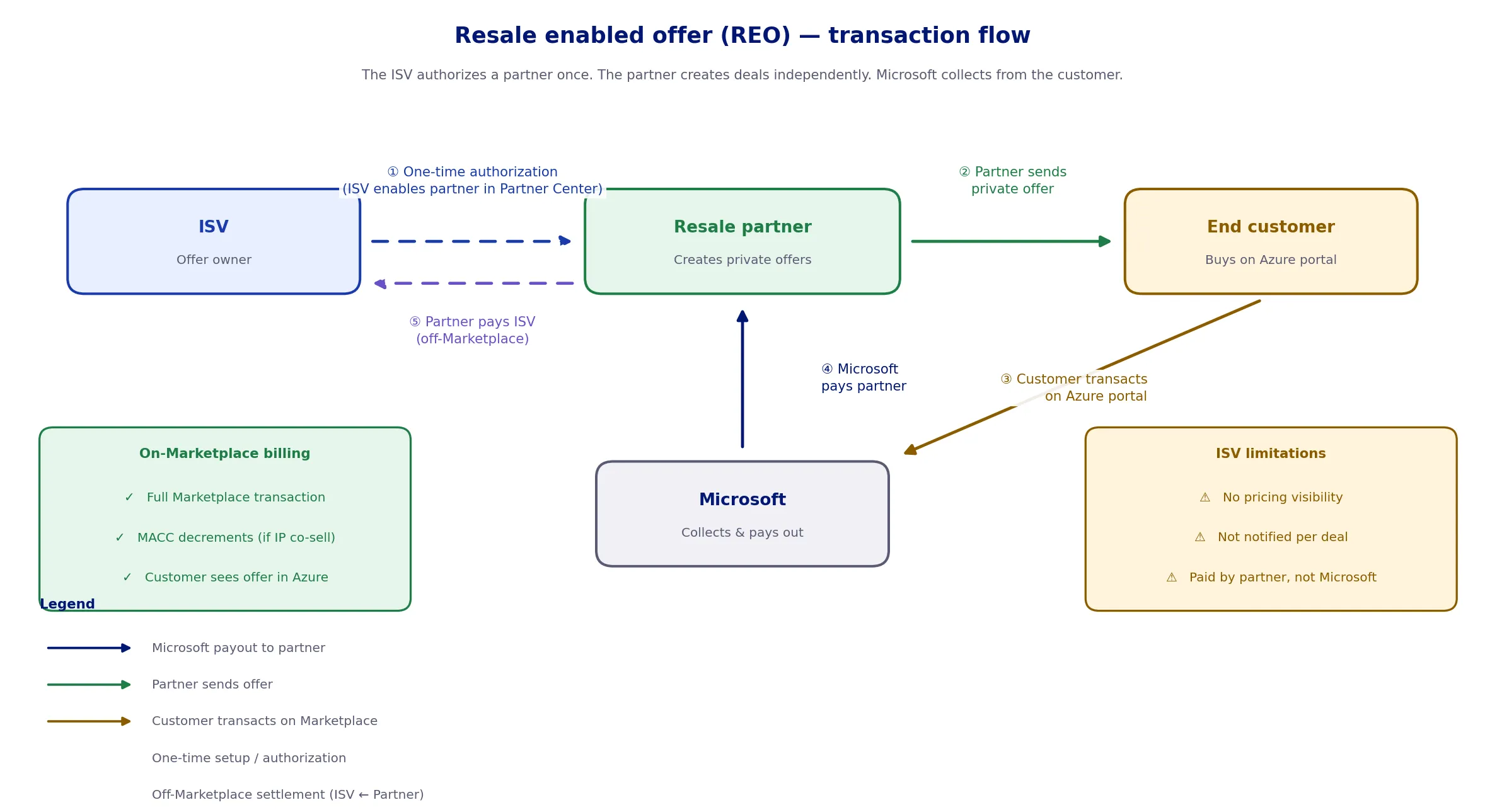
The customer buys directly through the Azure portal. If the offer has Azure IP co-sell status, the purchase counts 100% towards the customer's MACC.
Key facts
Dimension | Detail |
|---|---|
Who creates the offer | Resale partner — independently, per customer deal |
Who sets customer price | Resale partner — ISV has no visibility or control |
Marketplace transaction | Yes — customer buys through Azure portal |
MACC eligible | Yes — if offer has Azure IP co-sell status |
ISV gets paid by | Resale partner (off-Marketplace, per their agreement) |
Customer accepts offer | Yes — standard private offer flow in Azure portal |
🟣 When to use which
Use CSP private offer when
- You want to incentivize a specific CSP partner with a margin to sell your solution
- Your customer base is primarily SMBs managed by CSP partners
- The customer doesn't have an Azure commitment (MACC) to spend down
- You want Microsoft to bill the CSP, not the end customer directly
- You want a time-bound, partner-specific discount with a clear end date
Use resale enabled offer when
- You want to scale channel sales without per-deal ISV involvement
- Your partner works with enterprise customers who have MACC to spend
- You trust the partner to manage pricing independently
- You want global reach with minimal operational overhead per market
🟣 Important limitations to be aware of
CSP private offer
- Once extended, the margin cannot be changed before the end date — lock-in is immediate
- Only works with CSP Direct Bill and Indirect Providers, not Indirect Resellers (the ISV must extend to the Indirect Provider, who then works with their resellers outside Marketplace)
- Does not count towards customer MACC under any circumstances
Resale enabled offer (REO)
- ISV has no visibility into the pricing the partner charges the customer
- ISV is not notified when the partner creates a private offer
- Settlement between partner and ISV is managed entirely off-Marketplace — ISV takes credit risk on the partner, not on Microsoft